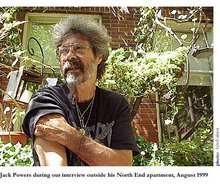
Thursday, October 8, 2020

Taped interview with Jack Powers with Doug Holder

 https://archive.org/details/z-0000133   Here is the link to the interview.....

Picture of Jack Powers and others from Stephen Gredler


Jack Powers center...


Gredler writes:


I lived on St. Stephen Street, St. Botolph Street and on East Eighth Street in Southie from 1977 to 1994.
I am from Historic Lexington (from 1949-1971)(from 1971 to 1976 I lived in Brockton)

I wrote my first ten books on St. Botolph Street.  My books are mostly poetry, with biographical sketches, and
photography added, totalling 25 books.

I read for Jack Powers twice, considered him a friend, a mentor, and a good promoter of poets and poetry.

Saturday, January 1, 2011

The Boston Globe: Jack Powers founder of Stone Soup Poets-- Obit.

The Boston Globe: Jack Powers founder of Stone Soup Poets-- Obit.
(Wendy Maeda/Globe Staff/File 1987)

Jack Powers, 73; helped poets bring verses to life


Jack Powers, who grew up in and near projects in Roxbury, founded Stone Soup nearly 40 years ago.

By Bryan Marquard
Globe Staff / October 16, 2010

Poems were more than just words on a page for Jack Powers, who believed that verse needed to be freed from the confines of musty books and the stuffy halls of academia.
Mr. Powers, who died Thursday in the North End, founded Stone Soup nearly 40 years ago. Young and old, beginners and accomplished writers, the ever-changing collection of Stone Soup poets met every Monday night to recite in a series of venues before an attentive audience that was not above voicing its opinion. The readings gained a national profile as he persuaded poets such as Allen Ginsberg, Lawrence Ferlinghetti, Gregory Corso, and Robert Bly to participate.

The performances, Mr. Powers insisted, were part of the poetry.

“You translate yourself when you speak a poem,’’ Mr. Powers told the Globe in 1992

“I think the most important thing for a writer to recognize is that this on the page is one thing. The delivery of the same is a translation. There are a lot of nuances, and lots of times I’ll change words. I’ve never read a poem the same way twice.’’

An activist who gave away everything from the coats he wore to uncounted hours helping the poor, he was a poet and publisher, a teacher and organizer, a man whose great height still seemed too small to contain his frenetic energy.

A series of strokes over the past several years slowed Mr. Powers, then silenced his voice and constrained his mind. He had lived in the North End for many years and was 73 when he died in the North End Rehabilitation and Nursing Center of complications of dementia.

“Boston is full of elite universities and institutions, often very exclusive, where if you don’t have an academic pedigree you’re out of the scene,’’ said Doug Holder, a poet and teacher who at one point worked with Mr. Powers on the Stone Soup readings and founded Ibbetson Street Press. “What Jack did was bring poetry to the people. He published books and had a venue where all kinds of people came through. He opened it up in Boston, which was old and stodgy until Jack brought a populist flavor, a new flowering of poetry.’’

Years before poetry slams made open mike nights fashionable, Mr. Powers insisted that poetry should be an event, something to add to each week’s calendar.

“He really did devote his life to keeping poetry as part of the public discourse, and he did it with great verve and enthusiasm,’’ said poet Gail Mazur of Cambridge. “He wanted to gather everyone into the performance of poetry. In that way, he was a little ahead of his time.’’

The oldest of six children, Mr. Powers grew up in and around housing projects in Roxbury and graduated from Cathedral High School in the South End. A semester studying chemical engineering at Northeastern University was enough to show him his path lay elsewhere.

He traveled to California, spent time in San Francisco, and returned to New England to write about sports for a New Hampshire newspaper. Then he came home to Boston, where he worked in a bookstore and launched a life of social activism.

At various points during the late 1960s and ’70s, Mr. Powers founded a free school on Beacon Hill and started free suppers for the elderly in the same neighborhood. He helped launch free concerts on Boston Common and taught remedial reading at the Columbia Point housing project, where he also organized a food co-op.

“I’m very solid on volunteerism,’’ he told the Globe in 1987, “because the extraordinary weight of problems that visits the modern industrial society can’t be met with dollars alone.’’

Eric H. Sorgman of Randolph, a nephew who acted as guardian for Mr. Powers, said his uncle was known among his relatives for, among other things, donating his coats or gloves to those who were cold or in need.

“He was a philanthropist in the truest sense,’’ Sorgman said. “He didn’t have anything, really, but what he did have, he gave away, and he didn’t want praise or recognition. He felt good about helping other people.’’

Chief among those he helped were other poets. Some wandered into Stone Soup readings at places such as TT the Bear’s and Out of the Blue gallery, its previous and current homes in Cambridge. Others he found at home.

“He taught me about life and how to treat people,’’ said his son Andreas of Boston. “He inspired me to create and was a big influence on my writing. I would always run my writing by him, and he would write things for me. We would write back and forth.’’

Sarah Jensen, a Boston poet who began reading at Stone Soup nearly 20 years ago, said Mr. Powers made the gatherings “a welcoming place.’’

“No matter what level of poetry you were writing at, it was a comfortable place where you could have your moment on stage and be just as welcome as anyone else,’’ she said. “And he would tell stories about meeting and being friends with Lawrence Ferlinghetti and Allen Ginsberg. It was a passing down of his experience to the newer poets, a passing down of history.’’

In addition to his son Andreas and nephew Eric, Mr. Powers leaves his wife, Tamara Oraschewsky of Boston; another son, John Kolya of Boston; two sisters, Cecelia Sorgman and Maureen Daniels, both of Quincy; and two brothers, Colin of Carver and Michael of Florida.

A memorial service will be held at 10 a.m. Oct. 24 in the International Community Church in Allston.

On Monday, Stone Soup will award its second annual poetry prize, named for Mr. Powers. A week later, on Oct. 25 at 8 p.m., the regular Monday gathering at Out of the Blue will be a memorial reading honoring Mr. Powers, who estimated that he stood up thousands of times to introduce poets. The beauty, he said, emerged from the unpredictable mix.

“Our readings are open,’’ he told the Globe in 1993. “A nightingale may come in and sing the most beautiful song, or a bat could fly in and scare everyone. You take some chances, but our audience is ready to listen.’’

Bryan Marquard can be reached at bmarquard@globe.com.


***********************************************************************************


Comments...


Oh, what a loss...a very great loss. I met Jack in the mid-90s. I don't know where he'd heard of me, but he called me to invite me to read for him at the Cantab, I believe it was called, in Central Square. He introduced me, and gave me about 20 minutes. Weeks later, he saw me on the street, recognized me, and said he wanted me to read for him once more. Alas, we never got in touch with each other again, and that I much regret. To me he seemed an unassuming guy who got things done---he promoted poetry in the area. He left a positive impression on me, certainly, for he was always willing to give established poets, fledgling poets, would-be poets, and diverse and variegated wordslingers and wordsmiths an opportunity to read from their work at his venue. He shall be missed.

Tino Villanueva


So passes a literary giant!! Jack Powers was one -of-a-kind spirit; a force of nature
to whom many of us owe our beginnings in the poetry world. Many of us would not be where we are today if it weren't for Jack's encouragement. In his own way, he achieved greatness but never actively sought it; yet recognition found him. It is amazing how much he accomplished living on a shoestring and a prayer. He was not perfect, but, according to some stories, many saints lacked perfection in their lives. In his way, Jack was the patron of the small press and numerous poets, not of the Academy. He was, despite himself, larger than life. Now he is legend as he joins those who made their literary mark over the generations. As a poet, he was spiritual , yet earthy; erudite , yet simple; profound, yet plain-spoken. He was also prolific in his out put. He had his issues; so do most of us. What artist doesn't have issues?
Jack has left us; however, I suspect he will continue with us in spirit. G-d rest him; G-d Bless!
Warmly,
Harris Gardner


.....I recall Jack back in the '70's or was it the '80's when he would swing by the Annual Greek Festival sponsored by the Holy Trinity Greek Orthodox Church on Park Drive in the Fenway with his young son perched on his shoulders.....you cld never mistake Jack with that unruly shock of black hair.....I also remember him from the time that the Stone Soup Gallery was in full swing just around the corner from MGH on Cambridge Street altho regretfully, I never attended any sessions....& I further remember him telling me about the free suppers that he organized at the Old West Church on Cambridge Street for the poor & his constant attempts to scrounge food around town for them.....& about him telling me about trying to get a job with the City to work on their Annual Arts Festival or Arts in the Park (or something like that).....I believe he did work for the City on some artistic endeavors, back then.

........I wonder how many young & not so young poets, poor & not so poor, were inspired, encouraged & supported by him over the years........I wld not be surprised if they number well into the hundreds & more... ....he was an icon in certain literary circles in Boston.....he will NEVER be replaced, he was unique among men, in so many ways.....

.......helen cox, 11 Park Drive, Fenway section of Boston.........


There was no sexism, no racism, no ageism at Stone Soup- and no favoritism. I remember when Chronicle visited T.T.'s, giving Jack some long-overdue and too-rare major media publicity. Who did he send up to read as scheduled? The most outrageous and least prime-time friendly poet of all, Lee Litif. Lee was scheduled to be #2, and Jack was not to take the scheduled spot away from anyone. Fair and balanced? That was Jack Powers. That's why he was the first to let the Slam in to his venue before deciding that competition was not right for Stone Soup. Jack was the patriot of all poets.

--- Susie Davidson
Posted by Doug at 3:45 AM
Labels: 73; helped poets bring verses to life, Jack Powers
2 comments:

Bridget Murphy said...

He forever gave of himself to his fellow man and woman. Jack's spirit of encouraging others was a revival experience in of itself. I consider myself fortunate for having been "reverenced" by thee. Thank you 'Jackie' for your PEACE & LOVE...you shall be missed dear ~ Bridget
8:39 PM
Joseph Baltar said...

I saw the best minds of my generation starving with madness and Jack was not one of them, well maybe just a dight.I met Jack in 1971 when he was running the Beacon Hill Free School. He allowed me to teach a course on Massachusetts Prisons and create a Film Festival Series on theHuman Potential Movement.Anecdotal #2 I was at his apartment on Joy street one day waxing about my love for Rilke. As I was about to leave he grabbed a xeroxed photo a friend had sent him showing her visiting Rilke's grave and gave me the special gift he had received from her.
Jack Powers was a poster child on how to love unconditionally .
I will leave you with the Ram Dass quote that"you are only as high as the people you hang out with".

Monday, September 17, 2007

Pictures From Jack Powers 70th Birthday by Steve Glines


Top Photo: Jack Power's son.

2nd from Top: Jack Powers and Margaret Nairn

3rd from Top: ( Right to Left) Doug Holder, Arthur Polonsky, and Sidewalk Sam

4th from Top: ( Right to Left) Rose Gardina, Kip Tiernan, Deb Priestly and Doug Holder

http://mail.is-cs.com/JACK/

The Pavement Picasso Celebrates the Peoples’ Poet: Jack Powers: Interview with Sidewalk Sam


(Sidewalk Sam accepts an award)


The Pavement Picasso Celebrates the Peoples’ Poet: Jack Powers: Interview with


Sidewalk Sam


By Doug Holder


Sidewalk Sam is a Boston-based street artist, who often uses sidewalks of the Hub as a canvas for his work. Sam believes bringing art to the people through his sidewalk paintings, outreach, and through his organization “Art Street.” So it seemed natural for Sam to be organizing a 70th birthday party for Boston’s poet of the people and founder of the venerable “Stone Soup Poets.” Stone Soup, since it was founded by Jack Powers on the foot of Beacon Hill in Boston in 1971 has been a venue for readings, and publishing. Powers and his band of brothers have published poetry books by folks like the San-Francisco poet and “City Lights” bookstore owner, Lawrence Ferlinghetti, and other known and unknown poets over the years. A slew of poets like Lyn Lifshin, Frannie Lindsay, Gregory Corso have read and passed through these poetic portals. And many more have got their first reading experience at this supportive venue. Currently “Stone Soup” is housed at the ‘Out of the Blue Gallery” 106 Prospect St. Cambridge, Mass., and meets at 8PM. I spoke with Sam on my “Somerville Community Access TV show “Poet to Poet: Writer to Writer.”


Doug Holder: I am told John Kerry discovered while you were painting on the street in Boston, and helped you get funding for your organization “Art Street.”


Sidewalk Sam: He said: “I want to connect you with a community group you could associate with.” He helped with “Art Street” which is an association of artists, poets, actors, musicians, who go out to the streets of Boston to celebrate humankind.


DH: You are organizing a birthday party for Jack Powers’ the founder of Stone Soup Poets. How his mission does compare to yours?


SS: I am a voice crying in the desert, making straight to the way of the Lord. And in a way that “Lord” is Jack Powers. Let me explain to you the vital role he plays in the 21st century. Society—modern life has been corrupted by commercialism and abstract giant powers working their will on we the little people. A gentle, giant began to fight out against this some forty or fifty years ago. A man named Jack Powers who was born into the projects of Boston and had every disadvantage given to him, but yet he emerged as a holy man. A visionary, a poet, someone who sees the beauty in daily life. And he brought his poetry out so that he could celebrate all of us. He has been doing this celebration of “you and me’ in his poetry for fifty years, without once thinking of personal gain, without making it an advantage for him, without caring about his own future. He wanted to bring beauty into the world and notice and mark the goodness in people. He has done this more completely than anyone I know in modern day life. He has it done it more than priests and nuns, philosophers, more than politicians. He brings a kind of “love” to “You and Me” and into all the things he does. It is almost a religious experience. What I hope to do is pause on his 70th birthday and have all of us appreciate people like this. Jack has turned every little gesture of everyday life into a prayer.


DH: How did you first meet Jack?


SS: I was doing drawings of old master paintings on the sidewalk: Rembrandts, DiVinci and so forth. Jack was reading poets like Ferlinghetti—poets of the Beat Generation. We were both celebrating little acts of consciousness in daily life, and we drawn instantly to each other. This was some fifty years ago when we were both in our late teens. We did not know how to be “great”’ or “imposing” or make it into the cultural scene. We thought that by being good and doing decent things was the way to go.


DH: You were the son of a Harvard professor. Jack was a son of the projects. Interesting chemistry for a friendship, no?


SS: But we noticed a similarity. Both of us were castoffs, but both of us were believers. I think of the early mystics, knowing their mission, and when they were in touch with a good human being.


DH: Can you talk about some of the projects you two have been involved with over the years?


SS: Oh, we had lovely projects. There was a derelict entrance way in the North End that passed under the elevated expressway, only a few short years ago. The Freedom Trail passed under the expressway. It seemed to lose itself in the ghoulish land of the underpass. The underpinnings of the expressway were dark and gooey, dripping and rusted. It was a scab on the city. I didn’t understand why such a place could exist in the entrance to the North End, one of the glorious parts of Boston. This was in the 80’s. We painted the underside of the overpass in bright blue. We painted gold stars on the ceiling and had cherubs flying on the walls. We painted pillars as if they were important cathedral pillars. We painted the sidewalk—we put in flower boxes, we put paintings on the wall, we had poetry and music on the street. The underpass was turned into a delightful place and people in the North End loved it!


DH: Jack moved from Beacon Hill to the North End, right?


SS: Jack lived on Beacon Hill at a time when it was known as: “Beatnik Hill.” He was gorgeous person in that area and era. He was a handsome and noble leader. Every inch a poet.


DH: Jack was known as a political and poetry activist. He established a food bank at Columbia Point, had poetry on the Boston Commons, started the Beacon Hill Free School, protested the Vietnam War, etc... But he is also a fine poet in his own right.


SS: I think he is a very good poet. His poetry has a strong sense of spirituality. He makes words special. He has the gift of having a large dramatic vision. But he has the ability to bring it down to the everyday. As an artist using the name: “Jacques Debris,” a genius name, he has used all kinds of left over things on the street and turns them into art. He found a piece of white stone and put it on a pouch on a plaque. This is in my opinion is one of the most beautiful, insightful pieces of art in the city of Boston. Jack has expanded his art into the field of social responsibility.


DH: You talk about rampant commercialism in art today. Do you think artist are more careerist as opposed to the 60’s?


SS: People have always looked out for themselves as best they could. I think each “age” of people has people looking out for themselves. But what is unique about Jack is that he is almost a saint, in the way he doesn’t look out for himself. He is a holy fool. He is willing to preach to the birds and bees because there is glory in it. He has respect for humans on the tiniest level.


DH: I was surprised with all that Jack did over the years he never had a teaching position in a university, etc… Do you think the “academy” didn’t know how to take him?


SS: This is the case. Because he wasn’t self-promoting, he runs the risk of passing away unknown. I think that would be enormous mistake.


For more info about Jack Powers go to http://jackpowerspoet.blogspot.com

Thursday, September 13, 2007

POET BEATRIZ ALBA DEL RIO ON JACK POWERS


Beatriz at top in hat...

Jack was an important inspiring force in my poetry life with his encouragement and his always generous sharing of his muse. We used to talk on the phone, at least, twice a day sharing poems. I always found his words both enchanting and challenging.


In turn, I assisted him in some personal matters so as to make his path smoother. My mission was for Jack to be in perfect health in order to offer everyone his strongest lyric spirit. I am a lawyer and a mediator and that has been my world for over 30 years of practice helping others to create better lives. An on occasion even the great poet needs someone to help him deal with the mundane. And that’s what I did.


This was 7 years ago, in 2000. Until I met Jack my poem writing was my secret, a lifelong secret. But one night that year a poet-friend and I ventured into a poetry reading in this darkish basement of the Middle East Restaurant in Central Square and I met Jack, a tall, handsome, gentle man: the force behind this place called Stone Soup Poets.


It was a crisp cold evening and my friend put my name in that strange unknown thing called an open mike list and I read one poem. People clapped quite a lot, Jack came to the stage, graciously congratulated me and encouraged me to read a 2nd poem which I did in English and Spanish.....and that was the beginning of both my friendship with Jack and becoming a regular at Stone Soup.


Soon thereafter I sent for the first time my poems to a contest and to my amazement I won the First Prize of the International Octavio Paz Poetry Contest. Jack then invited me to be the feature poet several times.


Jack introduced me to the poetry world by telling me stories about poetry and poets he knew, by reading to me his old and new work and that of others he admired, always encouraging me with my efforts. Then, I sent some of my poetry to the International Pablo Neruda Poetry Contest and I won the 3rd Prize.


9/12/07


BEATRIZ ALBA DEL RIO is a bilingual poet and lawyer. She has lived in Cambridge since 1982, city she adores. She was born in Buenos Aires, Argentina.


Beatriz won the 1st Prize of the 2002 Octavio Paz International poetry Contest (Poem: “Ser” = “To be”), the 3rd Prize of the 2003 Pablo Neruda International poetry Contest ( Poem “Tristesa de Abril”= “April blues”) and the 2004 Cambridge Poetry award with the poem MASKS OVER MASKS in the category “female erotic poem” and her poem “Black Crows” was nominated in the category “female love poem.” Beatriz just won the 2007 3rd Prize of the Der-Hovanessian Translation Prize for New England Poetry Club with her translated poem “Shapes of Grief” = “Formas de la Pena” by Mario Benedetti.


Her poetry has appeared in several anthologies and literary magazines. Beatriz is a member of the New England Poetry Club. Beatriz poetry teacher guru is Ottone Riccio.


As a lawyer, Beatriz represents abused and neglected children and parents, mediates conflicts between families and others, and does some international and copyright work. Beatriz’ languages: Spanish, English, French. She understands portuguese and italian. Beatriz’ mission as a lawyer is to help people to create better lives. Her poetry speaks of longings, of clash of cultures. Some of her poems are songs to the spirit and to the oneness of us all. She translates poems especially from Spanish, her native language.


If you would like to contact Beatriz you can write to her to P.O. Box 382344, Cambridge, MA 02238-2344 or you can email to her to badelrio@comcast.net

Wednesday, September 12, 2007

le imitation of a poem for Jack Powers

le imitation of a poem
for Jack Powers

Inspiration on the back, side,
inside flap of an old utility bill
three poems to be read once
then placed in a filing system
only a fireman could love:

“Old man, gimpy leg
rises for Madonna with child
noisy, smelly, subway car
modern manger, god bless, godbless”

“Screams to the Almighty
beseeching victory over that man
murder, mayhem, to the infidel
blasphemous, a pox upon your house
… all your houses ….
And we wonder why God is silent?”

“The Bus
Fellow travelers
much in common
strike a conversation
until our destination
alone again, fearful”

-- Steve Glines

Tuesday, September 11, 2007

stone soup 7.23.07 by Irene Koronas


stone soup 7.23.07


he never noticed
he never said
your poetry
even body motions
perform what is expected

always noticed
always longed
for his pat back
even a glance
always too short

he gazed over head
sure my poems did not
exceed a three minute limit

fifteen years since
his body still straight
i’m still short

his intention
never wavers

the pat on my back
not really a pat
his hands in praise, bend
a most delicate embrace

jack powers never noticed me
and when he does

* Irene Koronas is the poetry editor of the Wilderness House Literary Review, the author of several poetry chaps, and a full lenght collection of poetry. She is also an accomplished artist working in Cambridge, Mass. Koronas is the "scribe" for the "Bagel Bards" a group of poets and writers that meet in Somerville, Mass.

Monday, September 10, 2007

Poet Linda Lerner on Jack Powers


It was the mid 80’s; I only had a few publications and even fewer readings to my credit when I went to First Night hosted by Jack Powers. Leo Connellan, my unofficial mentor, introduced me
to Jack before then with stories of when they slept under bridges in San Francisco, living a kind of road-life as struggling poets; I was really curious about this man who already loomed up as a legend for me.


Jack didn’t disappoint. On the contrary, from the beginning I was awed by how compassionate and open he was to each person who got up on the stage, exerting control by his non judgmental presence. And presence is what Jack has in abundance. The one criteria he transmitted as being important in a poem is honesty.


I didn’t read that night--even in the open. Maybe I was more than a little awed by it all and just being a participant was exciting enough. Eventually, with Leo Connellan’s recommendation, Andrew Gettler and I went on to feature at TT the Bear (where Stone Soup readings were held in the early 90’s.) Jack offered us hs apartment on Joy Street to stay (where he lived at the time) and, to give us some privacy, spent the night at his girlfriend’s place. That was the kind of thing Jack would do over and over for people.


Going to Boston to read at Stone Soup became an annual ritual for us during the next few years. I can’t begin to enumerate how many readings I’ve given since, how many hosts--some quite good--I’ve met, different places I’ve read in, since those magical times. And none quite compare. None have quite that magic. It wasn’t the place, but Jack, who transformed another weekly poetry event to the level of something more. Of Poetry. Jack is the real thing. I feel very fortunate for starting out there. Something I will always treasure.


Thank you Jack,
and
Happy Birthday!


Linda Lerner

WHO IS LINDA LERNER?


Photo Credit: Andrew Gettler


Ten collections of Ms. Lerner's work have been published: the most recent Because You Can’t I will (Pudding House, 2005) and The Bowery and Other Poems (March Street Press, 2004) which was selected as Small Press Reviews’ Pick of the Month.

Her essay on the present state of American poetry, "Poems From The Crypt Don't Speak to Living People" appears in the Summer 2005 issue of New York Quarterly.

In 1995, Linda Lerner and her life partner, Andrew Gettler founded "POETS on the line", the first poetry anthology available on the Internet. For the Vietnam Veterans issue, Nos. 6/7 (1997-98), "POETS on the line" received a Puffin Foundations Grant and a Ludwig Vogelstein Grant. The online journal ceased publication with its Millennium, Nos. 9/10 (1999-2000), but its back issues will be be kept permanently up in online archive.

Ms. Lerner's poems have recently appeared in The New York Quarterly, Louisiana Review, Paterson Literary Review, Onthebus, Home Planet News, South Boston Literary Review (“Bullies” won its Spring 2002 poetry prize), Ragged Lion Anthology and Big Hammer.

She has read widely across the United states including The Knitting Factory, Bowery Poetry Club, The Cornelia Street Cafe and The Back Fence in New York City; the Cherry Valley Arts Festival (1998) in Cherry Valley, NY; Stone Soup Poets in Boston,Mass.; Arkore's Welcomed Words Spoken Word Series in Hoboken, NJ and The Barron Arts Center, also in New Jersey. On the West Coast, Ms. Lerner has read at Beyond Baroque in Los Angeles, CA.

Bookmark this page and check back often for updates such as new chapbook availability date and upcoming readings.

Poetry Workshop: For Jack Powers

poetry workshop
for Jack Powers

at least one time more, please,
would i like to make your acquaintance,
would i like to sit at your workshop table
and learn poetry techniques from you,
like i did five years ago, one rainy weekday,
with three of your steadfast groupies. And me
a wannabe, though for a suspended second.
so quick with words and style were you,
spurring us four to creating lines and lines
and lines of poetry. And me a wannabe
trying to figure out how the three groupies
could come up with the verses they did,
i didn’t understand. i didn’t understand
until years later when i typed up this
poem in celebration of your 70th birthday how
their brilliances only reflect your spirit and
vitality and talent that only you can spread around
so gently and so easily and so intensely. an hour passed
quickly at that workshop with me stumbling to catch up with
your three young adult friends, writing lines after
lines after lines. at least more time - however
briefly – would i like to, learn from you,
take another workshop, be tuned into your poetic
world. thank you, Mr. Powers, and happy 70th.

pam rosenblatt 09.09.07

Pam Rosenblatt is a poet and an arts/reporter for The Somerville News.

Sunday, September 9, 2007

Steve Gines on Jack Powers


Steve glines is the founder of The Wilderness House Literary Review http://whlreview.com and ISCSpress.com


When I used to hang out at the Grolier there was a constant coming and going of posing poets. Readings were largely for established poets and I was not established. There were no open readings and few open submission poetry journals. I complained about this state of affairs to Gordon Carnie. He gruffly told me that I should start my own publishing house (I did, it was called Brahman Publishing) and that the poets that strutted around his shop were awful. If I wanted to hear real poetry,experience real poets, I should go to Stone Soup and Jack Powers. From then on I've been a Jack Powers fan and an occasional visitor to Stone Soup. In 1998 my daughter Kitty wanted a venue to read her poetry.Remembering the gentleness and genuine welcoming atmosphere of Stone Soup it was the first venue we visited.

President of New England Poetry Club thinks back about Jack...


Diana Der-Hovanessian writes about Jack.

Diana has been the head of the New England Poetry Club for many years. Diana Der-Hovanessian’s 23rd book "The Second Question" was published this year by Sheep Meadow Press. She was Fulbright professor of American poetry twice and taught workshops on the poetry of human rights, translation, and writing at various universities. She was a visiting poet in the Mass. schools for 18 years. Her work has appeared in American Scholar, Paris Review, Poetry, Nation, etc. and has won awards such as an NEA fellowship, P.E.N./Columbia grant, the Paterson Prize, the Armand Erpf translation award. She is president of New England Poetry Club.


Join us for a celebration of Jack Powers' birthday Sept 15 5PM 30 Gordon St. Allston, Mass. Potluck dinner-- open mic-- Sidewalk Sam, Linda Larson, Marc Widershien, Bob Clawson, Dough Holder and others to read... Music from the "Blue Dust Drifters" and Jennifer Matthews.


A Letter for Diana-Der Hovanessian...


Jack and I were very young when we met. (Would you believe,
at a Harvard Extension school class given by Professor Theodore
Morrison on Creative Writing? )

He was young and handsome;I had just come home to Cambridge from New York. (My husband wanted to live in Utah, I wanted to stay in NY...we had compromised on Boston.)

I was already writing poetry and having some successes because
New England Poetry Club soon pressed me into membership and
their board. I hadn't even known it was prestigious. Jack asked
if I could help him become a member. He has stayed a member ever since.
Everyone says Jack is the most generous person in poetry. I can add, Yes, I know. He never stopped asking me to do readings for Stone Soup...even though I kept telling him,I loved writing but hated reading. He had me as the opener for Lawrence Ferlinghetti. And for Lyn Lifshin.

Each time he moved to a different venue
he insisted I had to help break it in. "Jack" I'd say," I'll come
but honestly I don't know how much good it will do."
"It will help us both, you and me,"
he insisted. He has a gift for warm friendships...and a gift for gab both serious and entertaining.

I remember the wonderful
talk he gave at the first panel discussion I organized for
the Boston Globe Book Festival. He was the expert on the vox populi
and the street poets, the small press poets, the self published poets, reminding us how Whitman started. The other people I remember
on the panel were founders of the original Poets Theater, and
Peter Davison for the literary press. It was a great panel. And Jack the most memorable.


And speaking of memory there were the Jack years at City Hall when we had poetry there. One was a great program called "First Ladies.." Jack and I invited the mayor's wife, the governor's wife, and some tv and radio women announcers to read from Anne Bradstreet, Phyllis Wheatley, Emily Dickinson . We had Frances Minturn Howard reading her grandmother's poem, The Battle Hymn of the Republic.
Thank you Jack for the lovely memories, and mostly for being yourself, Jack Powers,friend, poet, powerful advocate for poetry in Boston . Diana Der-Hovanessian

Poet Lyn Lifshin on Jack Powers


I got this statement from the acclaimed small press poet Lyn Lifshin. http://lynlifshin.com There is a birthday party for Jack Powers Sat Sept 15 30 Gordon Street Allston 5PM Reading Potluck dinner more info: http://jackpowerspoet.blogspot.com


From the time I met Jack Powers, I think in the mid seventies when he invited me to do one of several poetry readings to go along with the Boston Marathon, I never stopped being incredibly amazed at his generosity and gentleness. I had published a handful of chapbooks and books when we first met. Before that I had heard of Stone Soup and I think on my trip to Boston to Beacon Press, just as my first anthology, TANGLED VINES, was accepted, the writer I came to Boston with tried to find Jack but we couldn’t.

But from that first meeting and reading, I’ve rarely had so considerate and generous and supportive a host. He was so kind at all the readings. I know he paid me when he did not have the money and could not afford to. There was always a feeling of vibrancy and fun and excitement reading for Jack and talking with him. There was always an idealistic feeling that anything could be accomplished with poetry. I always felt he was a leader and in the little time I spent in Boston, always saw his gracious generosity and kindness with people from all backgrounds.

Not only did he pay me for reading when he couldn’t I’m sure afford to, at my last reading in Boston Jack refused to let me pay to ship my books back. I insisted and I’m sure it was not easy for him to box and mail the books I hadn’t sold but he simply would not take my check. I think I sent it and he tore it up.

Jack is unique. He has helped so many poets, been so sensitive. In a time when poetry has become so careerist, Jack’s passion, community concern and sweetness is very special. He towers over many poets, literally and metaphorically ...

Bio

Lyn Lifshin has written more than 100 books and edited 4 anthologies of women writers. Her poems have appeared in most poetry and literary magazines in the U.S.A., and her work has been included in virtually every major anthology of recent writing by women. She has given more than 700 readings across the U.S.A. and has appeared at Dartmouth and Skidmore colleges, Cornell University, the Shakespeare Library, Whitney Museum, and Huntington Library. Lyn Lifshin has also taught poetry and prose writing for many years at universities, colleges and high schools, and has been Poet in Residence at the University of Rochester, Antioch, and Colorado Mountain College. Winner of numerous awards including the Jack Kerouac Award for her book Kiss The Skin Off, Lyn is the subject of the documentary film Lyn Lifshin: Not Made of Glass. For her absolute dedication to the small presses which first published her, and for managing to survive on her own apart from any major publishing house or academic institution, Lifshin has earned the distinction "Queen of the Small Presses." She has been praised by Robert Frost, Ken Kesey and Richard Eberhart, and Ed Sanders has seen her as "a modern Emily Dickinson."

Tuesday, June 12, 2007

For Immediate Release: Legendary Boston Jack Powers Poet Celebrates 70th.

http://www.jackpowerspoet.blogspot.com

For Immediate Release: Legendary Boston Jack Powers Poet Celebrates 70th.


(Allston, Mass.) On Sept 15, 2007 at 5P.M at the International Community Church in Allston (30 Gordon St.) celebrated poet Jack Powers will celebrate his 70th birthday with a potluck dinner and reading.


Jack Powers is the founder of Boston’s legendary “Stone Soup Poets.” Founded in 1971 at the Charles Meeting House on Beacon Hill in Boston, Powers has lead this venue of readings, activism and publishing for well over thirty years. Powers was also influential in establishing the Beacon Hill Free School in the 1970’s, which encouraged people to teach and participate in educational courses for no charge.


Stone Soup Poets is almost as well known for its publishing history. Powers has published over 80 titles , including Powers’ personal favorite “Jack of Hearts,” by Lawrence Ferlinghetti. Powers has also published such poets under the Stone Soup imprint as the award-winning Franny Lindsay, and the late Black Mountain School poet John Wieners.


Powers has jumpstarted the careers of many well-known poets including the small press doyenne Lyn Lifshin. Folks like Beat bad boy Gregory Corso, Allen Ginsberg and Robert Bly have passed through Stone Soup’s poetic portal.


Stone Soup Poets has been housed for the last several years at the Out of the Blue Art Gallery in Cambridge, Mass. It meets every Monday at 8PM, and carries on the proud tradition with the help of poet Chad Parenteau.


The well-known Boston street artist and activist Sidewalk Sam, as well as Doug Holder of the Ibbetson Street Press, Rev. Lorraine Cleaves Anderson of the International Community Church, and Margaret Nairn president of Collaborative Artworks Inc, are organizing the celebration.
The reading and potluck dinner will have music provided by Boston -area poet and singer/songwriter Jennifer Matthews, as well as Powers’ sons.


All friends and acquaintances, and anyone who has been touched by Jack in his long literary outreach are invited to come. Bring a poem, a dish for the potluck, and a friend!
* For more information contact: Doug Holder 617-628-2313 dougholder@post.harvard.edu

Friday, April 13, 2007

Plum Island by Marc Widershien


A poem for Jack Powers by Poet Marc Widershien http://marccreate.com


Plum Island

Here the human is secondary
to the piping plover who lays its eggs
on the beach next to the dunes.

We humans may not cross the wires
strung out down to the shore.
Enough life has been destroyed for sport.

How good to feel a part of the sea beach--
its hunched rocks, and torn seaweed,
instead of its dominant presence.

We see just a scrim of Boston’s skyline,
the city we love but must occasionally flee.
Bird watchers cling to the roofs

of their cars, binoculars in hand.
How lean are the lines of the horizon
meeting the sandbar that protects the shore.

Driftwood pocked and eaten out by the wind and rain,
invite the human eye into the guts of the sacred.
Scrub trees anchor the sand. My steps are casual

but deep in the wavy dunes. I am protected
by the wilderness of red sumac
with their delicate furry stems.

Nothing flies without
the sun’s permission.
We wait for a change of wind.

Plum Island, Massachusetts, April 27, 2001
With Jack Powers

Poet Bob Clawson on Jack Powers


I showed some of my poems to Jack in 1997 and he said I was writing the bestnarrative poetry he'd seen in years. He encouraged me further by giving mea Stone Soup feature at a bar in Cambridge. So, I made up my first (and only) book, Nightbreak, gave a reading, sold a few books, and made $28 from pass the hat. Jack made me a professional. Thank you Jack, and a veryhappy birthday to you.
Bob Clawson

Thursday, April 12, 2007

Childhood by Jack Powers

Childhood--

When I was a child, everything

Was simpler.

No demons possessed me, no ghosts inhabited me.

When I was a child, the only thing that was disquieting

Was the sense of dream bordering

On nightmare,

Still I persisted on my route,

Letting nothing permeate my grandeur

After all this I learned to suffer,

Extremely.

I dared the fates to take me now,

I didn’t know where they would take me,

only to a pure and wholesome space.

We lived our lives believing in possibility

We ended up under the bed,

Hollering for the dad or mom.

I didn’t want this , but was insecure

In the passage.

My hand trembled, as too my soul,

I love you yet,

The magnificence of positive possibility

I have a cross to bear

As my savior before me.

Yes, I believe in magnificent

Dwelling place.

It will all come or come out.

We were born to joy,

Let us have it!

Jack Powers on Ferlinghetti

Stone Soup To City Lights: Jack Powers on Lawrence Ferlinghetti with Doug Holder

* this excerpt originally published in Poesy Magazine (2000)


Jack Powers is the founder of Stone Soup Poets, a venue of readings and publishing in the Boston and Cambridge area for over thirty years. He has provided a space for open poetry readings from poets from all walks of life. He has also published poetry books for a variety of known and unknown poets, including: Lawrence Ferlinghetti, who was a major player in the Beat Poetry Movement on the West Coast in the 50's. Jack recently visited Ferlinghetti in San Francisco where he still runs City Light Books. City Lights, the first all paperback bookstore, was founded by Ferlinghetti in 1953. Shortly after he formed a publishing house, creating his renowned Pocket Poet Series. Among the poets he published were: Allen Ginsberg, Gregory Corso, Jack Kerouac, Dianne DiPrima, to name just a few. I spoke with Powers about his recollections and his recent meeting with this legendary poet.

Doug Holder: Jack, you have told me more than once that Lawrence Ferlinghetti brought you back to poetry. What is it about the man that drew you to him?

Jack Powers: I think people of my generation were scared into a stasis in post-war America. I was turned on to Ferlinghetti when I read one of his books from the Pocket Poet Series Howl and other Poems by Allen Ginsberg. I came across it in a little bookstore at the corner of Mass. Ave and Huntington in Boston. In the late 50's I went out to San Francisco with a dear friend and discovered Ferlinghetti's City Lights Bookstore. I didn't actually meet Ferlinghetti until 1975. I was attracted to Ferlinghetti's poetry because it was written in the vernacular; he wrote about "high" things in the common tongue. Now in his 80's, he is still a very formidable presence. I feel he will be recognized as a great poet in his own right, beyond his role as a guru of the Beat Movement.

Doug Holder: Ferlinghetti, along with Peter Martin, launched the first all-paperback bookstore in 1953, and later formed a publishing house, starting with their Pocket Poet Series in 1955. Was your own publishing house, Stone Soup Publishing, modeled after Ferlinghetti's and Martin's efforts?

Jack Powers: It was impossible not to be influenced by something so beautiful. When I went out to "Frisco", and City Lights, I loved the feel of Grant St. ( home of City Lights), and the crazy people. When I say "crazy' I mean the label that mainstream society gave them. Here were these creative people spreading their wings, amidst the stifling conformity of 1950's America. The energy that came from that little bookstore in North Beach was inspiring. Ferlinghetti kept his "tire in track" simply put: he didn't kill himself with booze and drugs, like so many others. Kerouac, for instance drank himself to distraction and died in his 40's. Ginsberg bathed in the Ganges and was a master of histrionics. Ferlinghetti remained the solid core. Ferlinghetti was and is the model of the sober, committed artist. People could depend on him. He was the co-founder of the Beat Movement, but he was solidly planted like a tree. Every time I see Ferlinghetti I feel born again, flushed with new energy.

Doug Holder: Ferlinghetti published Ginsberg's "Howl" You published Ferlinghetti's "Jack of Hearts" Were there any similarities between the books?

Jack Powers: Ferlinghetti publishing "Howl" was a very natural development. He even wrote a poem "The Dog" in his book "Coney Island of the Mind", that was based on the poetical persona of Ginsberg: The Dog trots freely in the street and sees reality and the things he sees are bigger than himself and the things he sees are his reality Drunks in doorways moons on trees I believe Ferlinghetti and Ginsberg belong together. Like two dogs they walked the street and wrote about the stark reality...the wino, the aging drag queen, the ethereal shine of the moon on a tree. They were both living question marks, searching for a common truth.

Doug Holder: During your trip to the Coast you told me that Ferlinghetti showed you the cottage that he let Kerouac use to dry out and concentrate on his writing. Describe the setting, the feeling, the sense of place or presence there. Jack Powers: I remember touching the desk Kerouac did his writing on. I wondered how many words flowed from here. How incredibly privileged I was to be there. I followed a nearby creek to the Pacific. I stood in the ocean and said: "Thank you, I understand." Just like the creek, we start out as a mere trickle and make that universal passage to the sea, the world at large, the cosmos, what have you. The shore puts you in contact with constant reality, like a heartbeat. After I got back to Boston, I had the most remarkable thing happen: I saw my own aura around my arms and legs. I feel Kerouac gave me this gift.

Doug Holder: Ferlinghetti is in his 80's now and you are in your 60's. Will you be able to carry the torch for him? Jack Powers: I feel that I have to continue to carry the torch. I owe Lawrence for teaching me that each individual life means something. You don't have to be a Yale Younger Poet in order to say something. Lawrence believes as I do, that Americans are too into titillation, they don't read things that challenge them. I think the idea of producing challenging art forms is a common goal.

Jack Powers: The Middle Years

Jack Powers Interviewed by Doug Holder: The Middle Years Part 2

This is the second part of a series of interviews that deal with the founder of STONE SOUP POETS INC., Jack Powers. Stone Soup is a thirty year venue of poetry readings and publishing in the Boston and Cambridge area. The first segment examined Jack Powers's early years, from his birth at Boston City Hospital in 1937 to his Jack Kerouac inspired stint in San Francisco in the late 50's. In the following interview Jack discusses the genesis of Stone Soup, his political activism, and life on Beacon Hill in the 60's and 70's.


DH: Eventually you left San Francisco and came back to Boston. How old were you, and what happened then?


JP: I was twenty two. Shortly after returning I went up to New Hampshire to become a sports writer. I lasted about six months, because I couldn't stay out of Boston too long. I had a column in the Claremont Daily Eage, entitled: A SPORTING GLANCE. After returning to the Hub, I worked a thirteen year stint at Goodspeed Bookstore on Beacon Hill. During this time,I met a lot of interesting people , including Edmund Wilson, the literary critic, Red Skelton, the comedian, to name a few. I liked working there. I was a shipping clerk dealing with old and used books , situated in the basement of the shop. There was a pay phone down there, so I could work on my other projects as well. At the time I was dealing with the Anti- War Movement (Vietnam), and the Columbia Point Food Co-op. I guess at the time I felt the world was stalled. Without activism, the underclass was doomed to fall into deep despair and revolution. I didn't want a revolution.

DH: Was the idea for STONE SOUP brewing in the basement of Goodspeed?

JP: I was dealing with expensive books down there. I thought that it would be a good idea for a store where people could meet to exchange ideas, etc... that sold cheap books. When STONE SOUP started in 1971 at the foot of Beacon Hill, it was in essence a used bookstore. Many of the books we got were from friends. I worked full time at Goodspeed to support the store, because the store never made any money. John Lincoln Wright , the progressive country music muscian was our first employee.

DH: At Goodspeed you worked with Louisa Solano, who is now the propieter of Grolier Books in Harvard Square, a very famous poetry bookshop. Can you talk about your association with her.

JP: Louisa and I worked together for 10 years. She was a brilliant,and gifted individual. She started the Beacon Hill Anti- War Movement on her own. Together we started the Charles Street Fairs, in which we shut down blocks of Charles Street and presented music, poetry, anti-war literature, etc...

DH: What was Beacon Hill like in the 60's? What crowd did you hang with?

JP: I was unconnected to the poetry scene at that time. Poets like Stephen Jonas, John Weiners ( Measure Magazine), Joe Dunn ( White Rabbit Press), introduced me to the players in the literary crowd. The back of Beacon Hill( behind the State House) had an infusion of remarkable energy that was like Greenwich Village of the 30's and 40's. Rent was relatively cheap, and the living was easy. There was a community that was harmonized around issues like world peace, the ending of hunger...you name it. We articulated the isolation of the individual in society, and moved to the possibilty of communication. I first moved to Beacon Hill in 1961. I became an activist shortly after Kennedy was killed.

DH: When did Stone Soup start publishing books?

JP: This started when Stone Soup began in 1971. The first books we produced were STONE SOUP ANTHOLOGIES. It was our policy that anyone who read at our open mic could submit poetry, and have at least one poem accepted. In this way we would have a record of what went on. We produced probably 30 anthologies, all housed at our U/Mass Boston Library archive. We published some notable people, who went on to significance in the poetry world. We also published 80 poetry titles over the years. Our first book was buy a guy named Dan Shanahan. I met Dan at the Old West Church during an all night Jazz concert. I bought a copy of his anthology that he cheaply made, ROCK VIEW. I read a poem he wrote to his deceased father. It was so moving that I decided to publish poetry myself.

DH: When did you get involved with Boston Mayor Kevin White's administration? DH: There was a beautiful thing named SUMMERTHING, that was started by the deputy mayor, Kathy Kane,in 1968. I became the Beacon Hill/West End Coordinator for this program. We did all these remarkable things, like present string quartets on street corners around the city. Later I was to have the great fortune to be on the founding comittee of FIRST NIGHT( A City Wide New Year Festival). During 71 to72, I was the asst. to the director for CONCERTS ON THE COMMON. From'82 to'89 I was facility director for this series. After Concerts On The Common , I was hired to run the Mayor's Business Resource Bank. I found empty space at the old bakery run by STOP and SHOP, near South Station. We stored and donated million dollars worth of material to non-profits for five years. Eventually I left City Hall when Menino came in. I supported his opponent, so I was shown the door.

DH: You were also involved in the Columbia Point Food Cooperative, in Dorchester. Can you talk about that? JP: Louisa Solano was involved with the BOSTON MOVEMENT COOPERATIVE. I heard about it, I liked it, so I joined. I decided to take their idea that people could create their own food sevices, and empower themselves. In this case the target group was a group of low income African Amercians living in a Dorchester project. We picked up food cheaply at a food bank in Framingham and sold it to residents for half the normal price. The seven founders of this cooperative eventually moved out of the project. I felt we made a difference. These folks realized that they didn't have to stay tied to the tree, they could move on.

DH: You were involved in the Busing Crisis in Boston in the 70's. This was when Black kids in the city, were bused into schools of South Boston, a predominately White neighborhood at the time. Can you tell us about your experience?

JP: The first day of busing I wrote an editorial for the BOSTON GLOBE, THE KIDS DID IT ON THEIR OWN. My point was how sad it was that adults couldn't solve the issues another way. Why did kids have to be crushed into buses, only to be shipped into hostile areas. I worked as a bus monitor for 6 weeks during the crisis. People were throwing rocks at the buses, that were chock-full of Black kids. One husky white kid, was particurally destructive with his rock throwing. He was getting ready to hit my bus, so I jumped out and tackled him, and put him in a head lock. I then lead him to some officers down the block and left him there. Later I had to be present at a hearing for the kid. The judge claimed I used to much force! Talk about irony!

by Doug HolderThis interview originally appeared in Spare Change, Boston MA.